
Humanoid Robot Walking
How Robots Learn to Walk Like Humans
Humanoid robot walking is one of the most challenging problems in robotics. A humanoid must coordinate many joints, maintain balance on two relatively small feet, respond to sensor feedback, and adapt its movements as conditions change.
Unlike a wheeled robot, a humanoid cannot simply move its body forward. Each step changes its center of mass and the forces acting on the ground. Walking therefore requires the integration of mechanical design, sensing, motion planning, control, and increasingly, artificial intelligence.
Some Key Points
Humanoid walking combines motion planning, state estimation, balance control, and joint-level control.
Modern systems can combine model-based methods such as ZMP and MPC with learning-based approaches such as reinforcement learning.
Successful locomotion depends on both software and hardware, including actuators, sensors, mechanical compliance, and efficient energy use.
Humanoid Walking Terminology
ZMP — Zero Moment Point: A classical concept for analyzing dynamic balance in bipedal locomotion.
MPC — Model Predictive Control: A control method that repeatedly predicts future system behavior and optimizes actions over a limited horizon.
IK — Inverse Kinematics: Calculates joint configurations needed to place a robot’s body part at a desired position and orientation.
Inverse Dynamics: Calculates the forces or torques required to produce a desired motion while considering the robot’s dynamics.
RL — Reinforcement Learning: A machine-learning approach in which an agent learns behavior through interaction and reward.
CPG — Central Pattern Generator: A mechanism for generating rhythmic movement patterns, inspired partly by biological locomotion.
State Estimation: The process of combining sensor measurements to estimate the robot’s current physical state.
Humanoid Walking: From Command to Movement
A humanoid walking system can be understood as a pipeline:
Walking command → motion planning → continuous state estimation + perception → locomotion control → joint commands → actuators
The exact architecture varies between robots. Some systems rely heavily on model-based control, while others use learned policies. Many modern approaches combine both.
Sequence of actions
1. Determine the Desired Movement
The robot receives a command such as:
Walk forward
Walk backward
Turn
Stop
Change speed
Move toward a target
A higher-level planner determines the desired direction and velocity. The locomotion system converts this objective into appropriate foot placements and body movements.
2. Plan Foot Placement
The robot determines where each foot should land.
Foot placement is critical because the feet define the robot’s support area. A poorly positioned foot can make it difficult or impossible to maintain balance.
Traditional humanoid walking systems have used concepts such as the Zero Moment Point (ZMP) to plan and control locomotion.
ZMP and Dynamic Walking
The Zero Moment Point (ZMP) is a classical concept in bipedal robotics used to analyze dynamic balance.
In simplified terms, ZMP identifies a point on the ground where the moments associated with the robot’s motion and ground reaction forces satisfy the conditions required for dynamic stability. Keeping the ZMP within an appropriate support region helps prevent the robot from tipping over.
ZMP-based walking is not simply static walking. A robot can use ZMP while moving dynamically and transferring its weight between its feet.
One limitation of classical ZMP-based approaches is that they are particularly suited to locomotion with continuous ground contact. They are less naturally suited to highly dynamic movements involving flight phases, such as running and jumping.
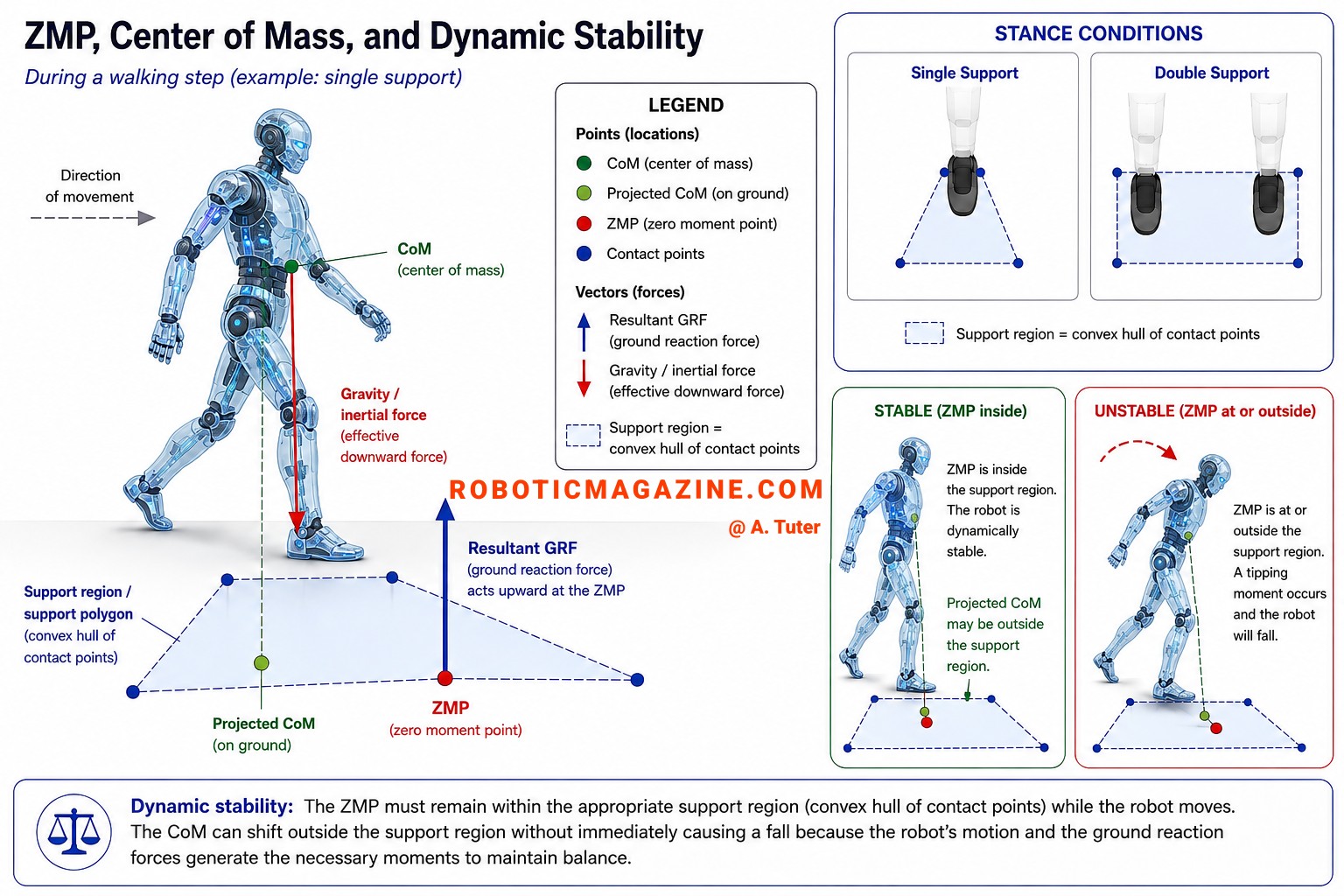
Modern humanoid systems therefore use methods including Model Predictive Control (MPC), whole-body control, contact-force optimization, and learning-based approaches.
MPC repeatedly predicts how the robot will move over a short future horizon and adjusts its actions accordingly.
Continuous State Estimation and Perception
A walking controller cannot make good decisions without continuously knowing the robot’s current state.
Humanoid robots use sensors such as:
Inertial Measurement Units (IMUs)
Joint encoders
Force and torque sensors
Foot pressure sensors
Cameras and other perception sensors
These measurements are combined through state estimation to estimate:
Body orientation
Joint positions
Joint velocities
Body velocity
Foot-ground contact
Position
External disturbances
An IMU can detect changes in orientation and acceleration, while joint encoders provide joint positions. Foot sensors can help determine whether a foot is supporting the robot.
Modern systems can also combine this proprioceptive information with vision. Depth cameras and other visual sensors can identify terrain, estimate elevation, select suitable footholds, and support reactive replanning.
The result is a continuous feedback loop:
Sense → estimate → plan/control → move → sense again
3. Shift the Center of Mass
Before lifting one foot, the robot must transfer enough weight onto the supporting leg.
This requires coordinated movement of the hips, pelvis, torso, knees, and ankles. Moving one joint changes the position and momentum of other parts of the body, making humanoid walking fundamentally a whole-body control problem.
4. Move and Place the Foot
Once the robot has transferred sufficient weight to the supporting leg, it lifts the other foot and moves it toward its planned location.
The swing leg must:
Clear the ground
Avoid obstacles
Reach the planned position
Have the correct orientation
Make controlled contact with the ground
Two techniques connect planned movement to individual joints.
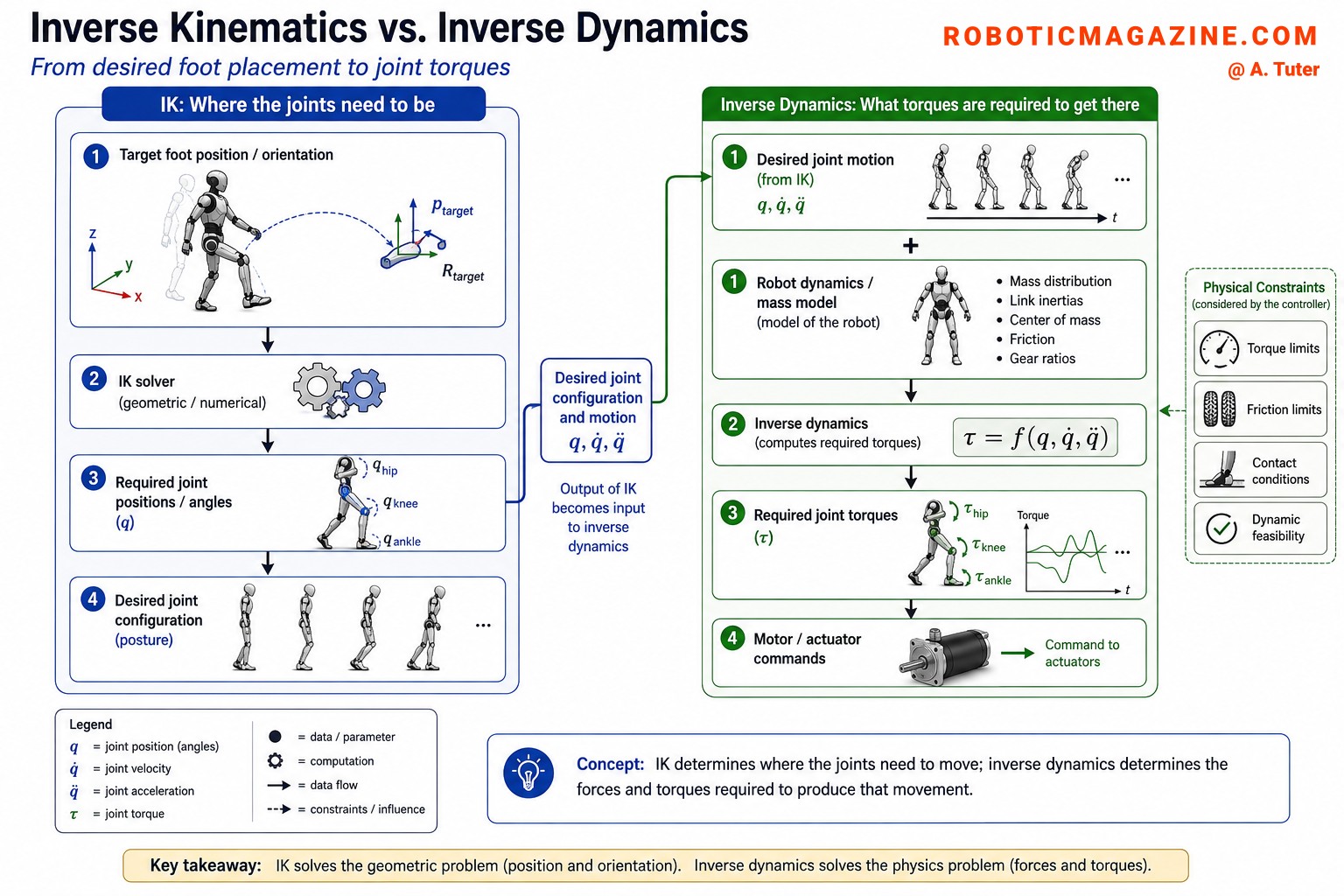
Inverse Kinematics
Inverse Kinematics (IK) determines the joint configurations required to place a particular part of the robot—such as its foot—in a desired position and orientation.
Desired foot position → IK → joint positions
Inverse Dynamics
Inverse Dynamics considers the forces and accelerations required to produce the desired movement.
Desired motion + robot dynamics → required joint torques
Together, these techniques bridge the gap between a planned walking trajectory and commands sent to the robot’s actuators.
5. Transfer Weight and Repeat
After the foot contacts the ground, the robot transfers its weight onto the new supporting leg.
The previous supporting foot becomes the swing foot, and the process repeats.
Humanoid Walking Is a Hybrid Dynamical System
Walking combines continuous movement with discrete changes in contact.
While a foot is in the air, the robot follows one set of dynamics. When that foot touches the ground, the forces and constraints acting on the robot change abruptly. The robot may then transition between single-support and double-support phases before the opposite foot lifts.
This makes humanoid locomotion a hybrid dynamical system: continuous physical motion combined with discrete contact events.
Modern controllers can explicitly account for these changing contact modes when the robot walks over uneven terrain, changes direction, or reacts to unexpected contact.
Different Approaches to Generating Walking Motion
There is no single method that all humanoid robots use to generate walking behavior.
Model-Based Control
Model-based approaches use mathematical models of the robot and its dynamics to calculate how it should move.
ZMP-based methods and MPC are examples of model-based approaches.
Central Pattern Generators
Central Pattern Generators (CPGs) generate rhythmic patterns without requiring a separate command for every individual movement.
They are inspired partly by biological locomotion, where nervous systems generate repetitive patterns associated with walking.
In robotics, CPGs can generate rhythmic leg movements and coordinate repetitive locomotion.
Reinforcement Learning
Reinforcement learning (RL) takes a different approach. Instead of manually specifying every movement, researchers train a system through repeated interaction with an environment.
The learning system can be rewarded for objectives such as:
Moving forward
Maintaining balance
Following a desired velocity
Avoiding falls
Recovering from disturbances
Reducing unnecessary energy use
The learned policy can then generate movement based on the robot’s current state.
Reinforcement Learning Does NOT Simply Replace Traditional Control
Modern humanoid locomotion should NOT be viewed as a simple progression from:
ZMP → MPC → AI
These methods can exist at different levels of the same system.
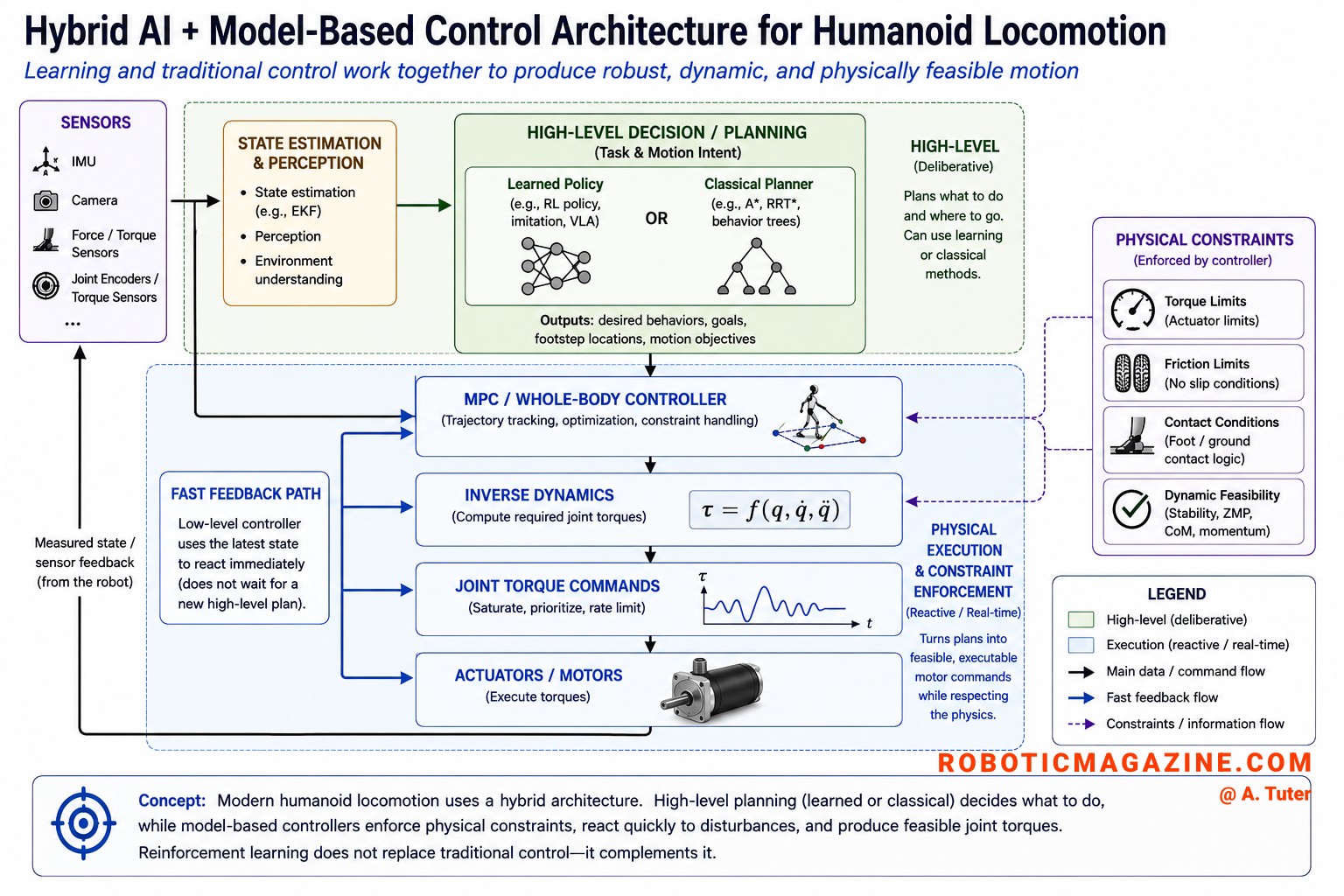
A simplified HYBRID architecture might look like:
Sensors
↓
State estimation + perception
↓
Learned locomotion policy / motion planner
↓
MPC or whole-body controller
↓
Inverse dynamics
↓
Joint torque commands
↓
Actuators
The higher-level system might determine a desired velocity, foot placements, or contact schedule. Lower-level controllers can then enforce constraints such as torque limits, friction limits, contact conditions, and dynamic feasibility.
The exact division varies between robots. Some systems may rely more heavily on learned policies, while others place more responsibility on model-based controllers.
Learning-based and model-based approaches are therefore not necessarily alternatives. AI can determine useful movement while conventional control helps ensure that the resulting behavior is physically executable and stable.
Simulation Before the Real Robot
Training directly on a physical humanoid can be expensive and risky.
A robot may fall repeatedly while learning a new walking behavior, potentially damaging motors, gearboxes, sensors, or structural components.
Simulation provides a safer environment for experimentation. Researchers can train a virtual robot while varying:
Ground friction
Terrain characteristics
Robot mass
Sensor noise
External disturbances
Actuator behavior
One major challenge is the sim-to-real gap: differences between the simulated robot and the physical robot.
Real-world friction, mechanical backlash, sensor noise, actuator limitations, and impacts are difficult to reproduce perfectly in simulation.
Researchers can use dynamics randomization, system identification, domain adaptation, and residual learning to improve transfer. In DeepMind’s soccer-robot work, targeted dynamics randomization and perturbations helped achieve zero-shot transfer to real robots.
A Real Example of Learning-Based Walking
A useful example comes from Google DeepMind’s research on a small humanoid soccer robot.
In a 2024 Science Robotics study, researchers trained a low-cost, miniature Robotis OP3 humanoid robot with 20 actuated joints to play a simplified one-versus-one soccer game. The robot was trained in simulation and its learned skills were transferred to physical robots. The system learned behaviors including walking, turning, kicking, and recovering from falls.
Compared with a scripted baseline in that experiment, the trained robots:
Walked 181% faster
Turned 302% faster
Got up 63% faster
Kicked a ball 34% faster
These numbers describe that specific experimental comparison, not a general benchmark for humanoid robots or a universal improvement produced by reinforcement learning. They were achieved on a small research platform and should not be assumed to translate directly to full-size humanoids, which face greater torque, thermal, structural, and impact constraints.
The experiment demonstrated that learned locomotion skills could be trained in simulation and transferred to real hardware while producing agile behaviors.
Hardware Is Just as Important as Software
A sophisticated walking algorithm cannot compensate indefinitely for inadequate hardware.
Humanoid locomotion places demanding requirements on actuators and mechanical structure.
High-Torque-Density Actuators
The robot needs sufficient torque to accelerate and control its body while keeping joints relatively compact and lightweight.
High torque density is particularly important in the legs because actuators must repeatedly support and move a substantial portion of the robot’s mass.
Compliant Joints
Some humanoids incorporate mechanical or electrically controlled compliance.
Compliance can help absorb impacts when the foot contacts the ground and make interaction with the environment less rigid.
Sensors
Accurate joint, inertial, force, and perception sensors are essential because the controller needs reliable information about the robot and its environment.
Ultimately, dynamic walking is a combination of mechanical capability and control intelligence.
Energy and Battery Constraints
Walking has a fundamental energy problem.
A humanoid must carry its own batteries while repeatedly accelerating and decelerating its legs, torso, and arms. Inefficient movements can therefore reduce operating time significantly.
Energy efficiency is often evaluated using the Cost of Transport (CoT), a metric that relates the energy required for movement to the robot’s weight and distance traveled. Lower CoT generally indicates more economical locomotion. CoT is widely used to compare the energy economy of movement in robotic and biological systems.
Energy efficiency affects actuator selection, robot weight, gait design, battery capacity, cooling requirements, and task duration.
A robot may be capable of very dynamic movements, but if they consume too much energy, they may not be practical for long-duration work.
Efficient walking is therefore also about making the robot move economically.
A Growing Humanoid Robotics Landscape
Humanoid locomotion is being developed by a rapidly expanding group of companies and research organizations.
Boston Dynamics’ Atlas, Tesla’s Optimus, Figure’s Figure 03, Agility Robotics’ Digit, and Unitree’s humanoid platforms are some examples from the growing list. See top humanoid robots list here.
Google DeepMind partnered with Boston Dynamics to explore the integration of Gemini Robotics foundation models with Atlas, illustrating how advanced physical hardware can be combined with increasingly capable robot AI.
The approaches differ considerably, from industrial deployment to general-purpose physical intelligence and lower-cost hardware.
Impressive demonstrations should not automatically be confused with fully mature general-purpose robots. Reliable operation across diverse real-world environments remains a difficult engineering challenge.
Real-World Adaptation
Walking across a perfectly flat laboratory floor is only the beginning.
A useful humanoid eventually needs to deal with:
Uneven floors
Slopes
Stairs
Different friction levels
Unexpected obstacles
External pushes
People moving nearby
Vision can help the robot understand these environments. Depth information and terrain representations can support foothold selection, while reactive replanning can adjust the walking strategy when the environment differs from the original plan.
If the robot’s foot lands differently from what was expected, the controller may need to immediately modify the rest of the body’s movement.
This ability to react to disturbances is a major difference between a carefully scripted demonstration and robust real-world locomotion.
Risks and Limitations
Despite rapid progress, humanoid walking still presents major engineering challenges.
Falling
A bipedal robot has a relatively small support area compared with many-legged robots. A significant walking error can therefore result in a complete loss of balance.
Energy Consumption
Dynamic walking can consume substantial energy. A robot must balance mobility and performance against battery capacity and operating time.
Hardware Stress
Walking creates repeated loads on motors, gearboxes, bearings, joints, and structural components. Highly dynamic movements can increase mechanical wear.
Unexpected Terrain
A controller trained primarily on predictable surfaces may struggle when it encounters significantly different terrain.
Safety
A humanoid robot can be heavy and powerful enough that a fall or collision presents a safety risk. Industrial deployment also requires safeguards such as torque and speed limits, fall detection, and controlled operating modes.
Conclusion: From Walking to Dynamic Whole-Body Skills — Dancing, Martial Arts, Acrobatics, and More
Modern humanoid robotics has moved well beyond the era when simply walking across a flat floor without falling was a major milestone. Today’s leading humanoids can perform backflips, frontflips, parkour-style movements, martial-arts sequences, rapid changes of direction, synchronized movements, and recovery from large disturbances. These highly dynamic behaviors are no longer isolated demonstrations of a single research breakthrough; they increasingly appear across laboratory experiments, public demonstrations, and company showcases. The challenge has shifted from simply achieving dynamic motion to making these capabilities controllable, adaptable, repeatable, and useful in real-world tasks.
But how does a robot actually produce something as complex as a kung-fu sequence or a dance routine? At a high level, the movement first has to be represented as a whole-body motion: desired positions and orientations for the torso, arms, legs, hands, and feet are specified over time, together with information about when and where the robot is expected to make or break contact with the environment. This reference motion can come from motion capture, human demonstrations, animation, manually designed trajectories, or a learned policy. Motion retargeting maps a human or reference movement onto the robot’s different body proportions and joint limits, after which trajectory optimization or a learned controller can modify the motion so that it is dynamically feasible on the real robot rather than merely visually similar.
The resulting motion is not simply played back like a video. The same IK, inverse-dynamics, and whole-body-control layers used for walking must coordinate much more complex whole-body trajectories while accounting for the robot’s mass, inertia, contacts, torque limits, friction, and joint constraints. If the robot is pushed or lands slightly differently from the planned trajectory, state estimation detects the change and the controller can modify the motion rather than blindly continuing the original sequence.
For highly dynamic movements, learning becomes particularly powerful. Deep reinforcement learning, often trained at massive scale in simulation with domain randomization and motion-capture or other motion priors, can discover control policies for running, jumping, kicking, recovery, and acrobatic movements. Millions of simulated trials can be performed without damaging hardware, while randomized masses, friction, actuator characteristics, delays, and external disturbances can make the resulting policies more robust to differences between simulation and reality. After sim-to-real transfer, learned policies can be combined with model-based control. A high-level system may determine the intended movement. Learned and model-based layers then continuously work together to keep the motion physically feasible and react to unexpected contacts or disturbances.
These sequences also illustrate the hybrid dynamical nature of humanoid movement discussed earlier in this article. A robot may switch rapidly between different contact modes—standing on two feet, one foot, touching an object, landing after a jump, or having no ground contact at all. Flips and other aerial movements are particularly different from walking because there may be no supporting foot during part of the maneuver. The robot must control its orientation and angular momentum through coordinated movements of its limbs and torso, then prepare for a precisely timed landing. This is why techniques for ordinary walking cannot simply be scaled up to produce a backflip: the controller must handle different contact modes, momentum, flight dynamics, and impact conditions.
These advances are unlikely to come from a single technique or breakthrough. They depend on increasingly tight integration between mechanical design, high-performance actuation, state estimation, perception, motion planning, whole-body control, model-based methods, learning, simulation, and energy systems. The most capable humanoids will therefore be defined not by any one component, but by how effectively these systems work together as a unified whole-body platform. The remaining engineering challenge is no longer simply “Can a humanoid walk or perform acrobatics?” but whether these capabilities can be combined into reliable, efficient, safe, and useful behavior for extended periods in unstructured human environments. Sustained operation, low energy consumption, robustness to uncertainty, rapid recovery, and seamless transitions between locomotion and dexterous manipulation remain important frontiers.
Walking is still foundational, but it is now only one layer in a much richer stack of dynamic whole-body control and physical intelligence. And that larger stack deserves a closer look of its own. A future article will examine in greater depth how humanoid robots generate and control dynamic behaviors such as running, jumping, martial-arts movements, dancing, and acrobatics—from motion capture and motion retargeting to reinforcement learning, whole-body control, sim-to-real transfer, and aerial dynamics.
Terms of Use: Unauthorized copying is prohibited; we maintain dated records to document original publication. Content may contain inaccuracies. All trademarks mentioned belong to their respective owners; we are not affiliated with them, and no endorsement is implied. See our Terms Page.