Robotics News, Knowledge & Insight since 2008

Androids

Figure AI shows latest robot – Figure 03 -

Figure AI has just introduced its latest android robot, Figure 03. The new robot comes with a lot of improvements over the previous one, such as, redesigned hands including softer fingertips with improved grasp and new cameras in hands, wireless charging through electromagnetic induction, faster actuators with improved torque density, improved audio system, improved camera and visual perception capabilities, battery safety advancements, among others. About manufacturing, the company says that they established a new supply chain and revised their manufacturing process which included the company’s high volume production facility BotQ, in order to be able to mass produce the robot. Figure 03 is not only better but will also cost […] Read More

Main Components of a Humanoid Robot -

A humanoid robot has several main systems working together which are: Sensors: Cameras, microphones, tactile sensors, motion sensors and more…. AI: Through artificial intelligence, decision making, computer vision, navigation, motion planning, interactions with surroundings and all other systems are coordinated and managed. Power Supply and Management Systems: Optimization of energy usage and efficient usage of available power is one of the main goals. Actuation Systems: Presently rotating electric actuators are the main means of actuation in all advanced humanoid robots. Research is also underway for more humanlike, tendon based actuation systems. Control Systems: Control system can be considered as a middle connection between the AI and all other systems, which […] Read More

Musk’s humanoid Optimus shows progress -

Elon Musk has just tweeted about his humanoid robot Optimus. It seems that the android is now capable of locating his own limbs in space and in connection with this, can learn tasks, even in a changing environment. The video in Musk’s tweet shows that the android can sort cubes based on their colors by picking them up by its fingers and can do this even when someone keeps changing the location and orientation of cubes deliberately. At the end of the video, the robot displays some acrobatic moves beautifully… A very promising video indeed… Terms of use:Copying or republishing of content of this website is not allowed without written […] Read More

Improving Stability of Bipedal Robots -

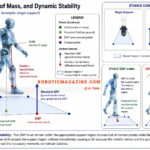
When building bipedal robots (robots that walk on 2 legs), ensuring stability is a primary objective. The following strategies are among the most important: 1- First of all, before even considering the rest, we need to make the physical shape and mass distribution as good as possible for a proper, stable stance. This simply means-the center of mass is as low as possible, (for example placing heavier components at the bottom and or making upper components of lighter weight material-the mass is distributed as evenly as possible-the mass bears on as wide surface area as possible (this can be achieved by positioning and proportioning of sizes of legs and feet […] Read More

Drywall installer Robot -

Japan’s new Humanoid Robot built by the Japanese Japan’s Advanced Industrial Science and Technology Institute is able to install drywall:   Source : https://www.aist.go.jp/index_en.html Read More

Fedor – Russia’s Robot Astronoaut -

Fedor is a humanoid robot in development in Russia, which is designed to help astronauts in space. It can turn valves, drive car, use drill, do pushups and a lot more useful tasks such as lifting up to 20 kg, walk, crawl, get into the car all by itself, turn door keys, and use various tools. Read More

Robots Learning To Pick Things Up As Babies Do -

Robots Learning To Pick Things Up As Babies Do Carnegie Mellon Unleashing Lots of Robots to Push, Poke, Grab Objects                Babies learn about their world by pushing and poking objects, putting them in their mouths and throwing them. Carnegie Mellon University scientists are taking a similar approach to teach robots how to recognize and grasp objects around them.              Manipulation remains a major challenge for robots and has become a bottleneck for many applications. But researchers at CMU’s Robotics Institute have shown that by allowing robots to spend hundreds of hours poking, grabbing and otherwise physically interacting with a variety of objects, those robots can teach themselves […] Read More

Sensing of touch between brain and robot arm -

In an experiment that was run by University of Pittsburgh and DARPA,  two microelectronic devices were placed on the brain of a volunteered patient, on a location where the brain processed tactile sensations, in order to achieve sense of touch between a robot hand and brain. After connecting electrodes from the brain to the robotic arm, the patient correctly was able to identify which finger were touched. In another experiment before that was run again by DARPA, it was demonstrated that the robot arm could be controlled directly by brain and now the feeling of sensation is added to this, which completes the loop. The rest will be just refining […] Read More

“Kibiro” Personal Robot -

UBIC and Vstone to Co-Develop “Kibiro” Personal Robot Capable of Understanding Human Preferences and Sense TOKYO, Nov. 17, 2015 (GLOBE NEWSWIRE) — UBIC, Inc. (NASDAQ:UBIC) (TSE:2158) (“UBIC” or “the Company”), a leading provider of Asian-language eDiscovery solutions and services; Rappa, Inc. (“Rappa”), a wholly-owned subsidiary of UBIC engaged in digital marketing; and Vstone Co., Ltd., a company engaged in the research, development, manufacture, and sales of omnidirect sensors, robots, and other electronic machines, announced today that they are co-developing a personal robot called Kibiro. Kibiro will be designed and manufactured by Vstone, and will be equipped with UBIC’s artificial-intelligence (AI) technology. Rappa will be responsible for developing specific business applications. […] Read More