
Robotics News, Knowledge & Insight since 2008

Service Robots > Civil Mission Robots

NASA Robot Curiosity starts drilling on Mars -
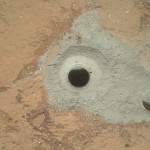
NASA Rover Curiosity used its on-board drills for the first time on February 8th, to sample Martian rock. The robot dug a hole of 2.5 inches deep and 0.63 inch diameter into the bedrock, in order to collect rock sample, which will be studied to gather evidence of the history of the planet. The collected sample will be analyzed by the instuments inside Curiosity within the next few days. The sample will first be analyzed for any Earth material which might have been accidentally stuck on the equipment.                 Sources: http://www.jpl.nasa.gov/spaceimages/details.php?id=PIA16726 http://mobile.reuters.com/article/idUSBRE91808U20130209?irpc=932   Read More

RASSOR: the Mini-Mining Robot of NASA -

The newest space explorer of the National Aeronautics and Space Administration (NASA), RASSOR is a mining robot at the prototype stage for now, but landing a similar robot to moon is planned. It is both an autonomous and a teleoperated mobile robotic platform with space excavation abilities and can be regarded as a closer step to have a lunar base that is sustainable. RASSOR is the acronym of Regolith Advanced Surface Systems Operations Robot and pronounced as “razer”. The applications of RASSOR are described by NASA as follows: Extraterrestrial in situ resource utilization (ISRU), construction operations in space, space mining of soil and water ice, robotic mining operations and autonomous […] Read More

Robonaut 2 is ready -

The second version of Nasa’s famous robonaut is ready for its new mission. The robot has recently been introduced to the press and seem to be able to move its arms almost lke a human. The robot is designed to perform tedious and repetitive tasks for the astronauts. Reference: http://www.floridatoday.com/article/20100813/NEWS02/8130327/1006/news01/Lifelike+robot+signs+on+to+serve+astronaut+masters Read More

Robots to clear Earth’s orbit -

Hundreds of satellites orbit our planet today and the number is increasing at an accelerating rate. The geostationary orbit, a fixed distance from earth surface, enables satellites to remain at a fixed location in comparison to earth’s surface, only occurs at somewhere around 22000 miles (around 34000 kilometers) above earth. Due to the evident advantages of putting satellites at such an orbit, this orbitting distance gets more and more crowded as new satellites are added. Currently there are around 200 dead satellites that crowds this orbit and the number is expected to increase many times in the coming years, according to the observer magazine of UK. To solve this problem, […] Read More