
NetSense: AI-Powered Drone Detection
A collaboration involving Lockheed Martin, Verizon, Nvidia and Keysight Technologies is testing an AI-powered system called NetSense that turns existing 5G networks into tools for detecting and tracking unmanned aircraft. During a July demonstration in the Miami area, the system showed that commercial cellular infrastructure can help monitor drones without depending entirely on specialized detection hardware.
The technology could be deployed around airports, stadiums, utilities, schools, hospitals and other critical facilities.
Source: https://www.tipranks.com/news/the-fly/lockheed-martin-collaborates-with-verizon-nvidia-and-keysight-on-netsense-thefly-news
———-
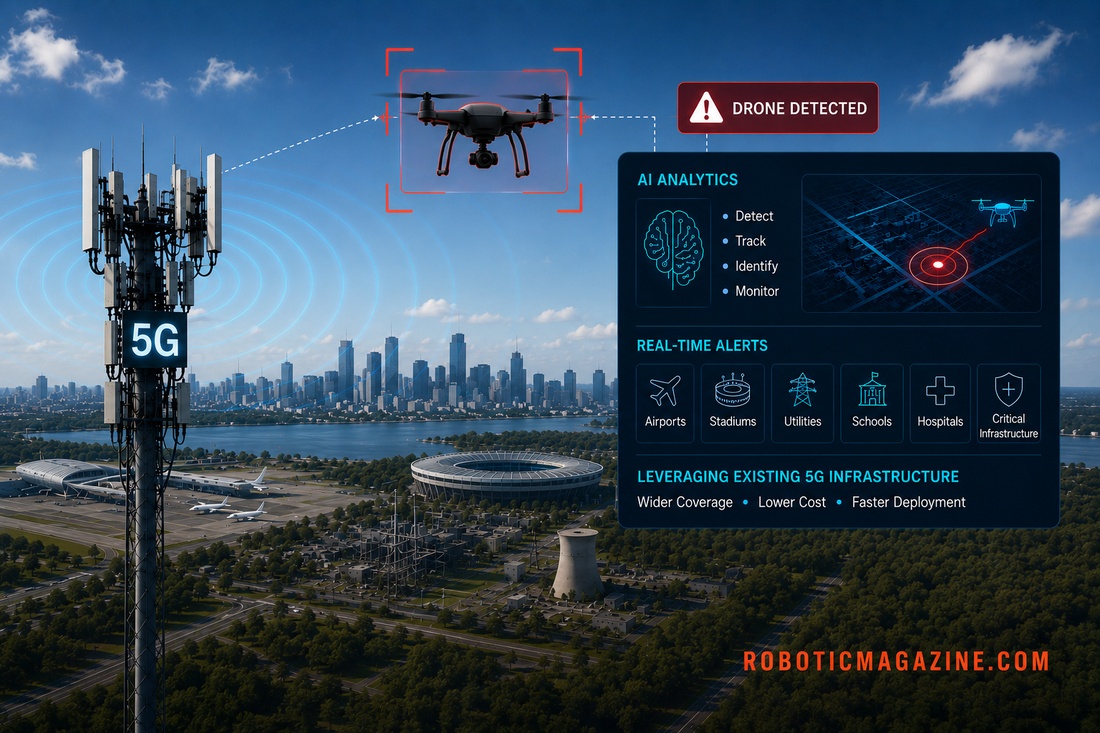
In our opinion, the broader significance of NetSense is that it could make drone detection more scalable by using communications infrastructure that is already widespread. If the approach proves effective in real-world deployments, organizations may be able to add aerial monitoring capabilities without building an entirely separate network of detection systems. That could be particularly relevant in locations where unauthorized or unidentified drones create security concerns, including airports and other sensitive facilities. The collaboration is also notable because it combines expertise from defense, telecommunications, AI computing and electronic test equipment. In our view, the most interesting aspect is not simply detecting a drone, but the possibility of turning existing cellular infrastructure into another layer of situational awareness for increasingly crowded airspace.
The primary barrier to widespread low-altitude drone detection today is the high cost of dedicated infrastructure. Traditional counter-drone solutions often require deploying specialized hardware—such as custom radar arrays, optical tracking cameras, and radio frequency sensors—at every site. For regional transit hubs, utility sub-stations, or public venues, building out and maintaining a dedicated sensor network from scratch can be cost-prohibitive. By using software and AI to process signal variations on existing 5G infrastructure, systems like NetSense aim to lower these entry barriers, shifting the focus from expensive new hardware installations to software-driven situational awareness.
Beyond installation costs, existing cellular networks offer an inherent advantage in spatial density. Mobile network operators have already deployed extensive networks of base stations and small cells across urban corridors, suburban communities, and critical infrastructure zones. These locations already feature reliable power, high-bandwidth backhaul networks, and coverage overlap. Leveraging this pre-existing footprint effectively turns everyday telecommunications infrastructure into a distributed sensing mesh, allowing security teams to extend low-altitude airspace monitoring without the logistical challenge of building new tower sites.
Terms of Use: Unauthorized copying is prohibited; we maintain dated records to document original publication. Content may contain inaccuracies. See our Terms Page.