
Four Years After ChatGPT: How Much More Efficient Has AI Become?
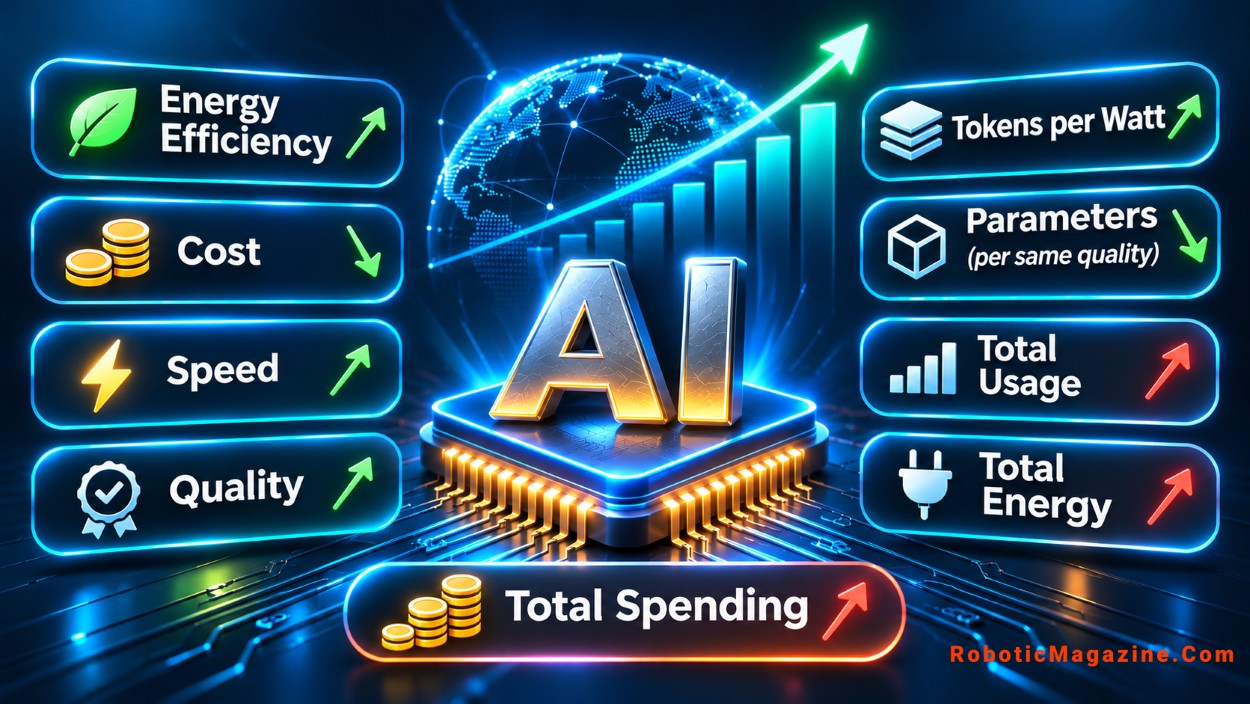
When OpenAI released ChatGPT on 30 November 2022, running a model of that quality was expensive, power-hungry and only possible in a large data centre. Four years later, the same level of capability costs a tiny fraction as much, fits on a phone, and uses far less energy per answer. The short answer to “how much has AI efficiency improved?” is this: for a fixed level of capability, the cost of using AI has fallen by an estimated three orders of magnitude (roughly 1,000x). But there is a twist: the best models people actually use today are bigger and think longer, so the total bill keeps rising.
AI text is processed in tokens, small pieces of text such as a word or part of a word. Efficiency is measured as the cost or energy per token or per answer, or as tokens processed per second. The fair comparison always holds quality constant: a cheaper answer that is wrong is not more efficient. So the figures below compare the cost or energy of reaching the same level of capability.
1The price of a fixed level of intelligence has collapsed
Stanford’s 2025 AI Index measured exactly this for GPT-3.5-level performance, the model behind the original ChatGPT. The price fell from about $20 per million tokens in November 2022 to $0.07 by October 2024, a 280-fold drop in under two years[1].
Epoch AI, an independent non-profit research institute that studies how AI is developing, has tracked the same trend across many benchmarks. On average, the price of a given performance level has fallen about 47% per quarter, or roughly 13x per year, though the pace slows as capabilities mature[2]. No single study covers all four years, so the ~1,000x headline is an estimate built from these measured trends, which mostly cover 2023 to 2025. Epoch notes that no other transformative technology, not computing, DNA sequencing or lithium batteries, has seen its price fall this fast[2].
2How much of that is genuine algorithmic efficiency?
Not all of the price drop is “smarter AI”. Some comes from cheaper hardware and some from competition squeezing margins. A 2025 MIT FutureTech study separated these effects. Looking at open-weight models and removing hardware price declines, it estimates that pure algorithmic efficiency in running models improves about 3x per year[3]. Training is improving at a similar rate: a study by Ho and colleagues found that the compute needed to train a model of a given quality roughly halves every eight months, close to 3x per year[4]. At a sustained 3x annual rate, efficiency would improve roughly 80x over four years, and hardware and competition multiply on top of that.
The algorithmic gains come from three main places:
-
Smarter architectures. In mixture-of-experts models, only a few specialised sub-networks (“experts”) work on each token, so a large model runs at the cost of a much smaller one. Many leading AI models now use this approach. Distillation lets a large model train a smaller one that keeps much of its ability.
-
Lower numerical precision. Quantization stores a model’s learned values in fewer bits, for example 4 instead of 16. That cuts storage roughly fourfold and reduces data movement and energy, as long as accuracy is protected.
-
Better serving software. Techniques such as FlashAttention, continuous batching, KV caching and speculative decoding, increasingly adopted since 2022, let the same chip answer far more requests.
3Models shrank by more than 100x for the same benchmark score
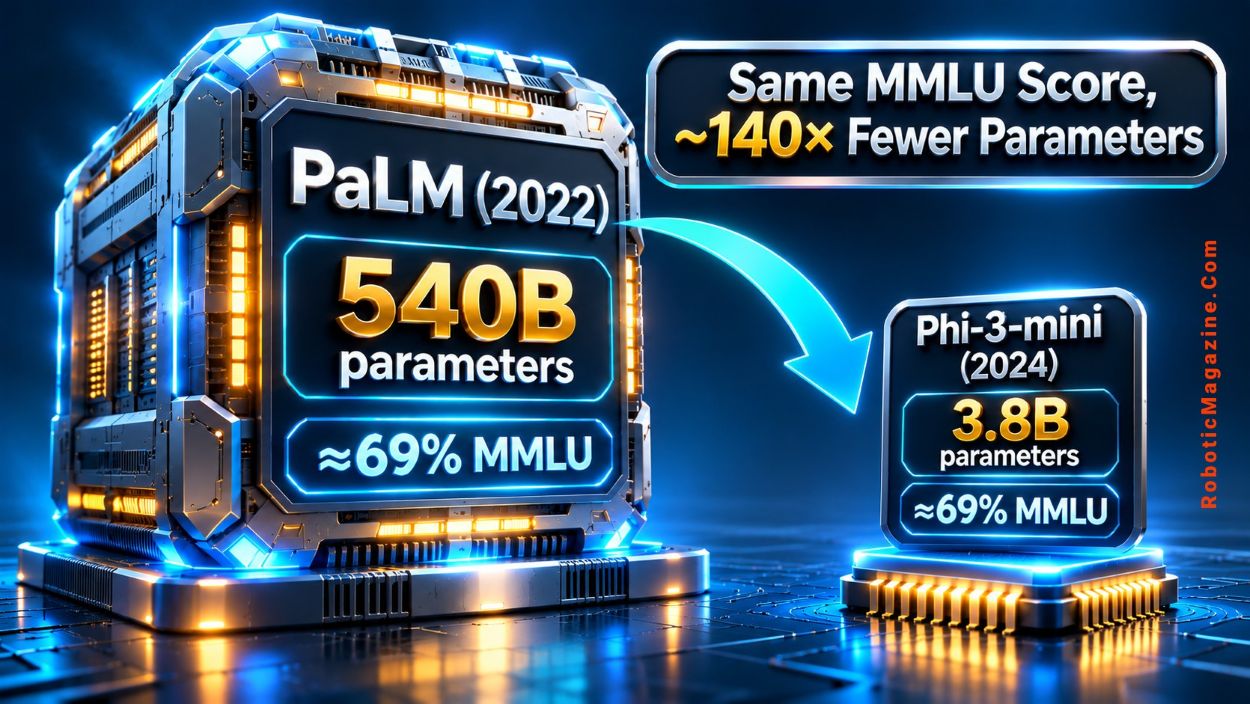
In 2022, Google’s 540-billion-parameter PaLM scored 69.3% on the MMLU knowledge benchmark, then a state-of-the-art result[5]. In April 2024, Microsoft’s Phi-3-mini, with just 3.8 billion parameters, scored 69% on the same test and runs offline on a phone[6]. That is roughly 140 times fewer parameters for the same MMLU score. Matching on one benchmark does not make the two models equal in every respect, and the two were not necessarily tested under identical conditions, but the reported scores are close enough to show the scale of the change. Phi-3-mini’s gains came from better training data, including synthetic data generated by larger models, and much longer training, not from architectural tricks.
4Training frontier-class models got far cheaper
DeepSeek-V3, released in December 2024, needed about 2.79 million GPU hours for its final training run, roughly $5.6 million at an assumed $2 per GPU-hour. Meta’s Llama 3.1 405B, which DeepSeek-V3 beat on most reported benchmarks, used about 30.8 million GPU hours, around 11x more[7].
The comparison needs care. The $5.6 million covers only the final run, not research, failed experiments or staff, and the two models were trained on different chips and setups. Nevertheless, the comparison shows how better model design and training methods can sharply reduce the resources needed to build a highly capable model, and DeepSeek’s techniques were widely adopted afterwards. Note that a model that is cheaper to build is not automatically cheaper to run: for a popular model, the energy spent answering questions can eventually exceed the energy spent training it.
5Energy per answer fell sharply
In August 2025, Google published the most detailed measurement yet from a major provider. The median Gemini text prompt used 0.24 Wh of energy, about the same as nine seconds of TV. Measured the same way, the energy per median prompt fell 33x between May 2024 and May 2025, while answer quality improved[8]. The figure covers chips, servers and data-centre overhead, but applies to a typical text prompt, not every AI task.
The savings came from more efficient models, better serving software and custom chips. Cleaner electricity cut the carbon footprint even further, but it does not reduce the energy each answer uses.
6Hardware and data centres: more tokens per watt
Chips improved alongside the software. A new chip can be faster and use less energy per calculation, even if its total power draw rises. In the 2024 MLPerf benchmark, NVIDIA’s Blackwell produced up to 4x more tokens per second per GPU than the H100 that launched around ChatGPT’s debut[9]. Faster memory, high-speed links between chips and liquid-cooled data centres add further gains, so more of the electricity a facility draws goes into computing rather than cooling and power losses.
7The catch: efficiency has not reduced total consumption
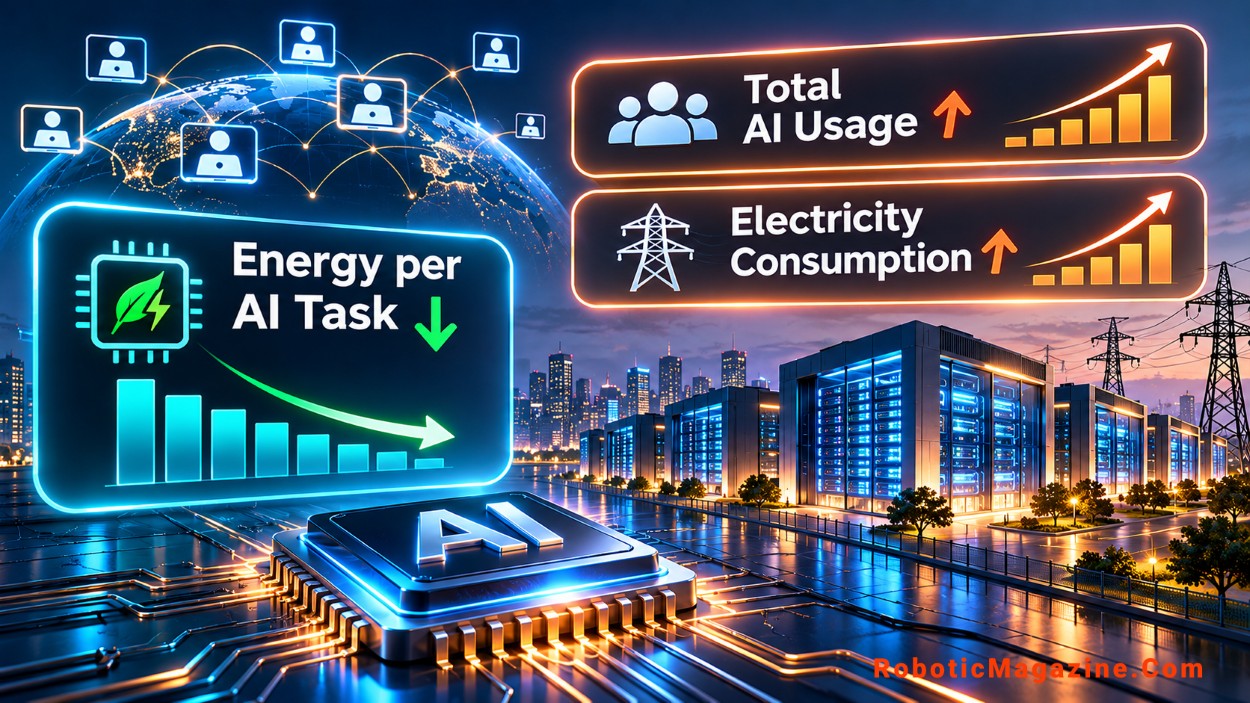
If AI is roughly 1,000 times cheaper, why are companies spending more than ever and utilities scrambling for power? Partly because of the Jevons paradox: when something gets cheaper, people use far more of it. If a task’s energy falls from 100 units to 10 but use grows 20-fold, total consumption doubles to 200.
Real-world data shows a similar pattern. Bain & Co. found that between December 2024 and December 2025, token costs halved while tokens consumed grew by about 450%[10]. The International Energy Agency reports that data centres used 485 TWh of electricity in 2025. Overall data-centre demand grew 17% that year, but AI-focused data centres grew 50%, and total use is expected to roughly double to 950 TWh by 2030, around 3% of the world’s electricity[11].
There is also a quality shift. People no longer want GPT-3.5; they want today’s best models. The MIT study estimates the cost of running frontier models is rising 3x to 18x per year, because models are larger and reasoning models generate many more tokens per answer[3]. AI agents and video generation push this further. Meanwhile power supply is becoming the limit: chips improve within months, but power stations and grid connections take years to build.
None of this means the efficiency gains failed. Without them, today’s usage would need many times more power. It means usage is growing faster than efficiency.
8How much further can efficiency go?
The human brain suggests there is plenty of room left. It runs on about 20 watts while handling perception, reasoning, memory and learning at once, whereas a large AI data centre draws tens or hundreds of megawatts. The comparison is not exact, since a data centre serves millions of users, but it shows how efficient intelligent processing can be.
The most visible payoff is edge AI: models running directly on phones, robots, cars and factory machines instead of remote data centres. For battery-powered machines, better efficiency means longer running time, less heat, or more capability in the same power budget.
The bottom line
These figures cover different periods and kinds of evidence, so they should not be multiplied together.
| Measure | Change | Period | Type of evidence |
|---|---|---|---|
| Price for GPT-3.5-level output | 280x cheaper ($20 → $0.07 per million tokens) | Nov 2022 – Oct 2024 | Measured (Stanford AI Index)[1] |
| Price for a fixed capability, full four years | ~1,000x or more | Nov 2022 – 2026 | Estimate, extrapolated from trends |
| Price for a fixed capability (average trend) | ~13x cheaper per year, slowing | 2023 – 2025 | Measured trend (Epoch AI)[2] |
| Algorithmic efficiency in running models | ~3x per year | 2024 – 2025 | Estimate (MIT FutureTech)[3] |
| Cost of running frontier models | Rising ~3x to 18x per year | 2024 – 2025 | Estimate (MIT FutureTech)[3] |
| Training compute needed for a given quality | ~3x less per year | Through 2023 | Measured trend (Ho et al.)[4] |
| Model size for ~69% on MMLU | 540B → 3.8B parameters (~140x fewer) | 2022 → Apr 2024 | Measured, one benchmark[5, 6] |
| Energy per median Gemini text prompt | 33x lower, to 0.24 Wh | May 2024 – May 2025 | Measured (Google)[8] |
| Tokens per second per GPU, H100 → Blackwell | Up to 4x | 2022 → 2024 | Vendor benchmark (MLPerf)[9] |
| Total data-centre electricity | 485 TWh; ~950 TWh expected | 2025; 2030 | Measured; 2030 projected (IEA)[11] |
In four years, the intelligence that made ChatGPT a sensation went from a costly data-centre service to something nearly free that runs on a phone. That is one of the fastest efficiency improvements of any technology in history. But efficiency has been spent, not saved: it has gone into bigger models, longer reasoning and far more usage. The real question for the next four years is not whether AI will keep getting more efficient (it almost certainly will) but whether demand will keep outrunning it. There is a business question too: whether revenue will grow fast enough to justify the spending. So far, investment has far outpaced income. One Stanford analysis puts the gap between the biggest tech companies’ AI spending and their AI revenue at nearly $1 trillion since 2024[12].
Sources
- Stanford HAI — AI Index Report 2025. https://hai.stanford.edu/ai-index/2025-ai-index-report
- Epoch AI — The plunging price of thought. https://epoch.ai/publications/the-plunging-price-of-thought
- Gundlach, Lynch, Mertens and Thompson — The Price of Progress: Price Performance and the Future of AI (2025, revised 2026). https://arxiv.org/abs/2511.23455
- Ho et al. — Algorithmic Progress in Language Models (2024). https://arxiv.org/abs/2403.05812
- Chowdhery et al. — PaLM: Scaling Language Modeling with Pathways (2022). https://arxiv.org/abs/2204.02311
- Microsoft — Phi-3 Technical Report (2024). https://arxiv.org/abs/2404.14219
- Simon Willison — DeepSeek-V3 (2024). https://simonwillison.net/2024/Dec/26/deepseek-v3/
- Elsworth et al. — Measuring the Environmental Impact of Delivering AI at Google Scale (2025). https://arxiv.org/abs/2508.15734
- NVIDIA — Blackwell sets new LLM inference records in MLPerf Inference v4.1 (2024). https://developer.nvidia.com/blog/nvidia-blackwell-platform-sets-new-llm-inference-records-in-mlperf-inference-v4-1/
- Fortune — Why AI spending is increasing as tokens get cheaper (2026). https://fortune.com/2026/06/17/why-is-ai-spending-increasing-as-tokens-get-cheaper-jevons-paradox/
- International Energy Agency — Key Questions on Energy and AI (2026). https://www.iea.org/reports/key-questions-on-energy-and-ai
- Axios — Investors’ P-doom scenario in AI: Lack of profits (2026). https://www.axios.com/2026/09/30/ai-profits-spending-hyperscalers
Post by: A. Tuter
Terms of Use: Unauthorized copying is prohibited; we maintain dated records to document original publication. Content may contain inaccuracies. All trademarks mentioned belong to their respective owners; we are not affiliated with them or any other entities mentioned, and no endorsement is implied. See our Terms Page.