
Robotics News, Knowledge & Insight since 2008

Various

Gripping any object easily -

Researchers have developed a new type of robot griping system, which is able to handle objects of any shape, by utilizing a complete different system than usual robot grippers. The system is based on a totally new concept of filling a flexible container, such as a party balloon, with granular material and removing the air in the balloon after the object is contacted. The researchers […] Read More

Robot learns archery -
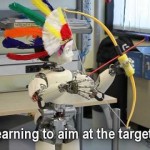
Developers of I-Cub have this time taught the robot how to shoot arrows. The robot learned to hit the target which was 3.5 meters away in eight tries. The ARCHER (Augmented Reward Chained Regression) algorithm is used to coordinate the movement of the hands, when it received feedback from its image sensors. An inverse kinematics controller is used to control the movement of arms. The […] Read More

Making robot development open source -

In an effort to encourage robot development in a more efficient manner, DARPA has recently anounced that there will be a dedicated research funding for small business robotics research. Back in July, the US government had also determined Robotics as one of the priority Research and Development priorities of 2012 budget. Among the many purposes that the robots will be developed are, defense, healthcare and […] Read More

Adding more autonomy to Robots -

In a new research and development project undertaken by DARPA, even more level of autonomy is aimed for robots. The goal of the project is to create robots that will be able to perform more advanced tasks by themselves, requiring only a high level of supervision from humans. The project team is divided into two, one team handling the hardware and the other software. iRobot, […] Read More

Robonaut 2 is ready -

The second version of Nasa’s famous robonaut is ready for its new mission. The robot has recently been introduced to the press and seem to be able to move its arms almost lke a human. The robot is designed to perform tedious and repetitive tasks for the astronauts. Reference: http://www.floridatoday.com/article/20100813/NEWS02/8130327/1006/news01/Lifelike+robot+signs+on+to+serve+astronaut+masters Read More

Optical sensors in robot skin -

To improve the sensing ability of robot skin, a research team in Ghent University in Belgium have placed optical sensors in place of the traditional pressure sensors or motor resistance. The main problem with the traditional approach is the underlying electrical components and wires are too inflexible and also increase chances of electromagnetic interference. To solve this problem, the research team made use of two […] Read More

Social and legal implications of developing robotics -

There is an undeniable fact that the robots are becoming more and more common in our daily lives. But what are the social and legal consequences? A recent news at Physorg.Com reports a Stanford University discussion about that kind of scenarios. Military, domestic, medical, industrial and all type of robots are all becoming more involved with humans as the artificial intelligence improves and enables them […] Read More

Ocean Probing Robots -

University of San Diego, CA, is developing small sized ocean probing robots with National Science Foundation support. The number of robots will be so huge that they will operate with swarm robotics concepts and each robot team will be made of hundreds of small robots reporting to a soccer ball sized main robot. Among many possible duties, the main task of the small robots will […] Read More

Intel says brain implant chips to control computers in 10 years -

According to the researchers at Intel, the largest computer chip maker in the world, we will have enough technology and all the means necessary to have computer chips implanted in our brains in 10 years, which will be able to control computers and all types of electronic devices and robots wirelessly, just by using brain waves. To achieve this goal, an important step is to […] Read More

Developing shapeshifting mini robots -

Researchers at Intel and Carnegie Mellon University are working on a revolutionary project to make distributed computing possible by using very small scale robots, where these will also be able to regroup themselves into any required shape of an object, that we commonly use in our daily lives. The researchers believe that there seems to be no theoretical obstacles and they have made a lot […] Read More