Robotics News, Knowledge & Insight since 2008

Robotics

Computer learns language and facts by itself -

Carnegie Mellon University Researchers, under the funding of Google and DARPA, and benefitting from the internet database provided by Yahoo, are working on a self learning computer algorithm that is able to extract knowledge from the internet by itself, to learn language and facts. The system is called NELL, which stands for “Never Ending Language Learning System”, scans hundreds of millions of web pages everyday, […] Read More

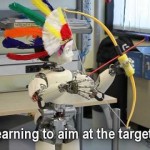
Robot learns archery -

Developers of I-Cub have this time taught the robot how to shoot arrows. The robot learned to hit the target which was 3.5 meters away in eight tries. The ARCHER (Augmented Reward Chained Regression) algorithm is used to coordinate the movement of the hands, when it received feedback from its image sensors. An inverse kinematics controller is used to control the movement of arms. The […] Read More

Making robot development open source -

In an effort to encourage robot development in a more efficient manner, DARPA has recently anounced that there will be a dedicated research funding for small business robotics research. Back in July, the US government had also determined Robotics as one of the priority Research and Development priorities of 2012 budget. Among the many purposes that the robots will be developed are, defense, healthcare and […] Read More

Researchers make artificial skin -

UC California Berkeley researchers have developed an electronic skin that is capable of sensing touch as sensitive and as fast as the human skin does. The approach was to use a thin rubber film that also includes capacitors to measure the pressures. The new approach, once out of the lab, could find applications in medicine, where restoration of sensation is required on some injured patients. […] Read More

Swarm Robotics Control Simplified -

Using Microsoft Surface software, which can be described as an interactive tabletop, a system to control swarm robots has been developed at MIT. Getting data from various resources, processing them and finally organizing the movements and outputs of swarm robot systems is the main challenge when desiging a robotic system based on a large number of robots. The new system simplifies this process by using […] Read More

Adding more autonomy to Robots -

In a new research and development project undertaken by DARPA, even more level of autonomy is aimed for robots. The goal of the project is to create robots that will be able to perform more advanced tasks by themselves, requiring only a high level of supervision from humans. The project team is divided into two, one team handling the hardware and the other software. iRobot, […] Read More

Robots to clean oil spill -

The robots built by MIT could help clean the oil spill at the surface of the ocean. Using swarm robotics concepts, 5000 of the robots is estimated to be able to clean the entire spill area at the gulf in one month. The robot digests the oil and works nonstop without any human intervention. Attached to the robot is a thin nanowire mesh that absorbs […] Read More

Machine learning by moving objects -

In a new research project done at Bonn-Rhein-Sieg Universities in Europe, researchers aim to teach robots about their environment by moving objects and their interaction with them. The experience that the robot develops form the input received after doing certain moves improves the robots prediction about the future events at its surroundings. Similar to human learning, the robot uses its sensors to receive input and […] Read More

Robotic developments of the year -

In a review published by the singularityhub, you will see various significant robot developments of this year. Most of these robots have also been covered in roboticmagazine, as they occurred, however we found this review interesting and a good wrap up of the whole year, so wanted to share with you. Please visit this link and enjoy… Read More

Optical sensors in robot skin -

To improve the sensing ability of robot skin, a research team in Ghent University in Belgium have placed optical sensors in place of the traditional pressure sensors or motor resistance. The main problem with the traditional approach is the underlying electrical components and wires are too inflexible and also increase chances of electromagnetic interference. To solve this problem, the research team made use of two […] Read More