Robotics News, Knowledge & Insight since 2008

Software / A.I.

Interactive Robotic Design Tool -

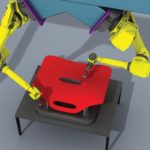
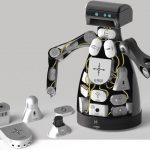
PITTSBURGH – A new interactive design tool developed by Carnegie Mellon University’s Robotics Institute enables both novices and experts to build customized legged or wheeled robots using 3D-printed components and off-the-shelf actuators.             Using a familiar drag-and-drop interface, individuals can choose from a library of components and place them into the design. The tool suggests components that are compatible with each other, offers potential placements of actuators and can automatically generate structural components to connect those actuators.             Once the design is complete, the tool provides a physical simulation environment to test the robot before fabricating it, enabling users to iteratively adjust the design to achieve a desired look or […] Read More

IBM to start working on Quantum Computers -

IBM has just started a new division, IBM Q, in order to start working on quantum computers. Although the technology to enable quantum computers are still in research phase, IBM executives believe that the current results are sufficiently promising, in order to start working. The company will, for now, create the infrastructure to work on Quantum Computers, such as creating APIs and simulators. Quantum Computers can be millions of times faster than even the most powerful traditional computers that we use today, because their calculations are not based on logic gates of transformators, such as 1s and 0s, but they work on the principal of electrons being able to exist […] Read More

ROS keeps growing in use -

Robot Operating System (ROS) http://www.ros.org Today by far the most commonly used robotics software is ROS, which stands for Robot Operating System. This is an open source software, and the most number of developers and robotics users are involved with this program with an ever increasing rate. It contains set of libraries, algorithms, developer tools and drivers for developing robotics projects. The first release of ROS was in 2010, and as of beginning of 2017, ROS has reached its 10th official release, which is called “ROS Kinetic Kame”. There are translations to 11 languages other than English, which are: German, Spanish, French, Italian, Japanese, Turkish, Korean, Portuguese, Russian, Thai and […] Read More

Microsoft and OpenAI to join forces for AI research -

It was recently announced that Microsoft and OpenAI, a non-profit AI research company will partner to develop AI that is open to everyone, with Microsoft’s open source deep learning software, Azure platform. In the official blog of OpenAI, it was stated that the access to faster machines provided by Azure will enable them to run their research more effectively. The results will be shared with everyone and open source software will be released. Robotic Magazine Read More

WorkFusion Intelligent Automation 2017 -

WorkFusion Intelligent Automation 2017 Brings 10x Performance Improvement to Enterprise Operations with Self-learning RPA and New Chatbots Product   NEW YORK – Oct. 27, 2016 – WorkFusion builds on its commitment to power the digital transformation of work by unveiling WorkFusion Intelligent Automation 2017. This first-of-its-kind offering provides all of the automation capabilities that enterprise leaders need to digitize their operation. The release advances WorkFusion’s Smart Process Automation product and introduces Chatbots and SmartCrowd products as a part of a full front-to-back-office digital workforce.   25 percent cost reduction in eight weeks with Smart Process Automation (SPA) The company’s flagship product allows operations leaders to rapidly augment their teams with software […] Read More

One billion people will use Watson by next year, IBM says -

In a recent conference organized by Wall Street Journal, IBM CEO said that the Watson AI program is to be used by a billion users by 2018. Watson is a natural language processing AI program, which made an impressive entry to news headlines, when it had defeated human champions in the game Jeopardy. Since then the software is constantly being improved, and two of the most significant uses are healthcare and customer services. For a detailed report see the article on WSJ. Read More

H-ROS – Hardware Robot Operating System -

As ROS – Robot Operating System is being used by more and more robots, a new form of building robots that uses ROS is coming into play, which is called H-ROS, Hardware Robot Operating System. This is currently supported by several companies that adopt its standard interfaces. Each piece runs ROS 2.0 on its own has its own ROS nodes and topics. Building robots is about putting together different H-ROS components that can come from different manufacturers but still inter-operate thanks to the standard hardware interfaces defined within H-ROS. The blocks that make up the system fall into 5 categories, which are, sensing, actuation, communication, cognition and hybrid components. The […] Read More

Robot Operating System (ROS) continues its growth -

Today by far the most commonly used robotics software is ROS, which stands for Robot Operating System. This is an open source software, and the most number of developers and robotics users are involved with this program with an ever increasing rate. It contains set of libraries, algorithms, developer tools and drivers for developing robotics projects. The first release of ROS was in 2010, and as of end of 2016, ROS has reached its 10th official release, which is called “ROS Kinetic Kame”. There are translations to 11 languages other than English, which are: German, Spanish, French, Italian, Japanese, Turkish, Korean, Portuguese, Russian, Thai and Chinese. It currently has 2000+ […] Read More

Robot teaches itself new task in 8 hours -

Deep learning is a relatively new but cery powerful concept for machine intelligence. Combined with cloud robotics, where robots share what they learn with each other immediately, this has huge potential in getting robots much more involved in our lives. Note that the artice discusses about industrial robots here, but, domestic robots will very soon follow as usual. For the detailed artice, see below: https://www.technologyreview.com/s/601045/this-factory-robot-learns-a-new-job-overnight/#/set/id/601069/ Read More

Scientists teach machines to learn like humans -

A team of scientists has developed an algorithm that captures our learning abilities, enabling computers to recognize and draw simple visual concepts that are mostly indistinguishable from those created by humans. The work, which appears in the latest issue of the journal Science, marks a significant advance in the field—one that dramatically shortens the time it takes computers to “learn” new concepts and broadens their application to more creative tasks. “Our results show that by reverse engineering how people think about a problem, we can develop better algorithms,” explains Brenden Lake, a Moore-Sloan Data Science Fellow at New York University and the paper’s lead author. “Moreover, this work points to […] Read More