Robotics News, Knowledge & Insight since 2008
Software / A.I.
I-cub, a project run in Eurpoe with participation from many Universities across the continent, is one of the most popular robot platforms in the world. The robot is taught how to recognize objects where the system is based on how young children learn. This brings the physcology, cogintive science and robotics field together. I-Cub learns the positions of the objects by correlating them to its body position and then it can predict where the object is going to be. For more and to see a video, see link below. Reference: www.kurzweilai.net/robots-on-tv-five-glimpses-of-future-machines?utm_source=KurzweilAI+Daily+Newsletter&utm_campaign=18a3b7df63-UA-946742-1&utm_medium=email
Read More
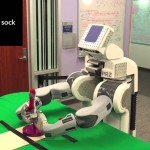
The robot developed at University of California, Berkeley has the software that can detect the state of an object such as a pair of socks being inside or out and then correctly flipping them. This simple task required precise grasping points and visual recognition, and seems to be a good example of robots performing more complex but repetitive tasks. See video below:
Read More
Using Microsoft Surface software, which can be described as an interactive tabletop, a system to control swarm robots has been developed at MIT. Getting data from various resources, processing them and finally organizing the movements and outputs of swarm robot systems is the main challenge when desiging a robotic system based on a large number of robots. The new system simplifies this process by using a common and user friendly software. A few common examples of the end uses of swarm robots are disaster response, search and rescue missions, military applications. For original story, please visit here. Reference: popsci.com
Read More
In a new research project done at Bonn-Rhein-Sieg Universities in Europe, researchers aim to teach robots about their environment by moving objects and their interaction with them. The experience that the robot develops form the input received after doing certain moves improves the robots prediction about the future events at its surroundings. Similar to human learning, the robot uses its sensors to receive input and process them. The prediction of its own actions become more and more clear with each experience the robot develops, similar to human learning process. Reference: www.physorg.com/news201880504.html
Read More
This software used in this robot allows it to avoid obstacles in 3D. Although obstacle avoidance is nothing new, performing in 3D and with this complexity requires a lot more sophistication than a simple 2 dimensional obstacle avoiding robot. Besides this robot is able to move so quickly that can be a lot more beneficial in flexible environments, while still perform the tasks required from a normal industrial robot. For original story and to see a video, please visit here. Reference: technologyreview.com
Read More
A project that European researchers completed created a technology enabling a computer to combine data from vision and sound at the same time. This makes it possible to understand things such as human behaviour or conversations. The project is named POP which stands for Perception-on-Purpose. Researchers indicated that this was a very complicated task as the dynamics of sound and visual perception are completely differentthan each other (although it has been known by the brain researchers that brain can process the final output similarly but here there was no reverse engineering of brain involved in that sense). During the course of the project, researchers also found out that combining these […]
Read More
At the Supercomputing Conference in Portland Oregon several days ago, IBM anounced that it has achieved the simulation of a brain with enough number of neurons and synapses of a cat brain. This is a step forward from the previous simulations, where a rat brain was simulated. This simuation, according to experts will lead to a better understanding of human cognition as well as brain structure, which does so much calculation efficiently with so minimal power. The simulator created 1 billion neurons and 10 trillion individual synapses and it runs on a BlueGene supercomputer. DARPA is funding the project. The goal is to create a processor that mimics mammal brain […]
Read More
Researchers at the Keiko Graduate School of media design in Tokyo, researchers have designed an iPhone application software that can control humanoid robot movements by using natural hand gestures. The walking motion for instance is achieved by doing a walking motion with index and middle fingers on the phone screen, while tapping the screen will make the robot jump. This also eliminiates the need for using joysticks etc.. to control robots or virtual game characters (although the software is only suited for the real robots yet). The software is not available for sale yet, but will be exhibited by December. See video below:
Read More
Scientists at University of California Irvine and San Diego is working on a project that will help identifying the decision making mehcanisms of the brain. The research involves monitoring decision making ablities of rodents during arbitrary change of food reward locations, where the animal needs to make new decisions and adapt to their new environment. In other words, the ultimate goal is to learn more about decision making when faced with uncertainity, where to date we have very little knowledge about. The data obtained from rodents will then be transferred to a software which controls a robot and then the robot will be expected to replicate the same kind of […]
Read More
The GPS devices are widely used today in our cars to help us find our way. The next generation of help is on the way, and it is a far more complex assistant than a GPS. Designed and developed by Volkswagen of America and the Massachusetts Institute of Technology (SENSEable City Lab and Personal Robots Group of Media Lab), AIDA stands for Affective, Intelligent Driving Agent. It is a compbination of a robotic head with an intelligent navigation system, that can familiarize itself with both the city and the driver. It has sensors both inside and outside of the car. The system does far more than showing the way between […]
Read More